
IRCC GCKey Portal, Express Entry Draws, Bill C-19 & Latest Immigration Updates
Navigating Canada’s federal immigration system starts with accessing the IRCC online portal through GCKey and understanding how Express Entry selection works. Since 2023, both the portal authentication and draw mechanics have changed – multi-factor authentication for GCKey, category-based Express Entry draws under Bill C-19 (also referenced as Bill C19 or simply C 19), and targeted NOC code selections for STEM occupations IRCC has prioritized.
GCKey Login: IRCC Canada Sign In
The GCKey (gc key) is a government-issued credential for IRCC Canada sign in and access to the online portal. Since mid-2023, all GCKey logins require multi-factor authentication. After entering a username and password, users verify identity through a one-time code via email or SMS.
| GCKey Feature | Details |
|---|---|
| Login URL | ircc.canada.ca → Sign In → GCKey |
| MFA Method | One-time code via email or SMS |
| Recovery | Security questions + email verification |
| Session Timeout | 20 minutes of inactivity |
| Alternative | Sign-In Partner (Canadian bank credentials) |
| Common Issues | Expired passwords (90-day policy), locked after 5 failed attempts |
IRCC Updates Today: Latest Policy Changes
For those tracking IRCC updates today and the IRCC latest update cycle, the department processed approximately 1.1 million applications in 2024. Key IRCC new updates include reduced immigration targets under the 2026-2028 Levels Plan (380,000 PR annually through 2028, down from 485,000 in 2024), with new temporary resident arrival targets set at 385,000 in 2026 and 370,000 in 2027-2028, expanded biometrics, and new service standards. The IRCC new update pattern follows seasonal cycles – major announcements in fall (immigration levels plan), with operational updates (IRCC news updates, processing changes, portal improvements) throughout the year.
Applicants frequently search for IRCC update today, IRCC latest updates, updates IRCC, and new IRCC updates – the IRCC newsroom publishes these on an ongoing basis. Following IRCC on official channels is recommended rather than relying on unofficial sources for the latest IRCC new update information.

IRCC Strike: Impact and Timeline
In April-May 2023, a PSAC strike – sometimes referenced as CIC strike by older terminology – affected 155,000 federal workers including ~12,000 IRCC employees. The IRCC protest and work stoppage lasted 12 business days. When did the IRCC strike end? When will IRCC strike end? When IRCC strike will end – these were top queries? The IRCC strike end date was May 1, 2023, with a collective agreement including 12.6% wage increases over four years.
Questions about IRCC strike 2023 how long it lasted were common – the answer is 12 business days. IRCC strike update today queries flooded social media during the disruption. The IRCC strike latest news at the time confirmed backlogs of 150,000-200,000 additional cases. IRCC strike updates came daily as negotiations progressed, and the IRCC strike update latest news confirmed resolution on May 1. The IRCC strike start date was April 19, 2023.
IRCC Announcement March 27 and PR Pathway
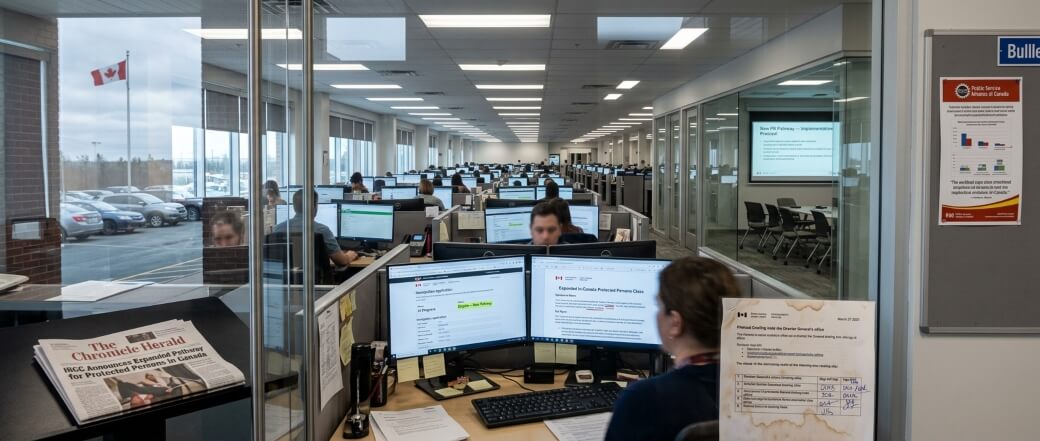
An important IRCC announcement March 27, 2023 expanded the in-Canada Protected Persons class, reducing processing times and eliminating certain medical exam requirements. Approximately 14,000 individuals were estimated eligible when this pathway launched.
“Even a two-week disruption had cascading effects that took months to resolve. The strike highlighted how dependent Canada’s immigration system is on timely processing.” – Andrew Griffith, former Director General, IRCC
Express Entry: Bill C-19 Immigration Changes
Bill C-19 immigration changes (also cited as Bill C19 immigration or Bill C19 Express Entry) amended IRPA to authorize category-based draws. Before this legislation (C 19), Express Entry draws were purely CRS-based.
Separately, Bill C-12 (Strengthening Canada’s Immigration System and Borders Act) passed third reading in the Senate on March 12, 2026, introducing reforms to the asylum system and border enforcement procedures.
| Draw Category | CRS Range (2025) | Frequency |
|---|---|---|
| General (all programs) | 490-535 | Bi-weekly |
| Healthcare | 430-470 | Monthly |
| STEM | 440-480 | Monthly |
| Trades | 380-420 | Monthly |
| Transport | 400-440 | Periodic |
| Agriculture | 380-430 | Periodic |
| French Language | 350-410 | Monthly |
In February 2026, Minister Lena Metlege Diab announced updated Express Entry categories for 2026. For the first time, a dedicated category was created for foreign medical doctors with Canadian work experience, recognizing the critical healthcare shortage. The 2026 categories continue to target healthcare and social services, trades, and French-language proficiency. Minister Diab stated that Canada exceeded its Francophone immigration target for the fourth consecutive year, reaching nearly 9% of admissions outside Quebec.
STEM Occupations IRCC and NOC Codes
STEM occupations IRCC has targeted include data scientists, software engineers, civil engineers, and biologists under the TEER system. STEM NOC code Canada listings eligible for category-based draws include: 21211, 21231, 21232, 21311, 20012, and 21110. The NOC code 2023 transition from the 2016 to 2021 system caused initial confusion, but IRCC published comprehensive mapping tables.
In 2024, ~12,000 ITAs targeted STEM candidates. ICTC projects Canada needs 250,000 additional tech workers by 2027. CRS scoring awards up to 1,200 points; a provincial nomination adds 600, effectively guaranteeing an invitation.
For provincial pathways, see the latest PNP draw results across Canada. Work permit options are covered in the PGWP extension and opt-in process and the TFWP, PGP, and RSWP federal programs.
Sources: IRCC newsroom, PSAC updates, Canada Gazette (Bill C-19), NOC 2021 tables (Statistics Canada), ICTC reports, IRCC Departmental Plan 2024-2025.